Fine Motor Activities for Toddlers (2026) – Simple, Fun Ways to Build Skills Through Play

Watching your toddler stack blocks, pinch playdough, or thread beads may seem like simple play—but these everyday moments are building blocks of lifelong learning. Fine motor activities for toddlers are essential for helping little hands develop strength, control, and coordination, preparing them for everything from holding a crayon to zipping a jacket.
**Please note that this article may contain affiliate links. You can read my full disclosure at the bottom of this page.
In this post, you’ll find engaging, easy-to-set-up fine motor skills activities for preschool and toddler-age children, perfect for busy parents, caregivers, and teachers. From sensory bins and sticker peeling to tweezing pom-poms and scooping rice, these activities don’t require fancy materials—just a bit of creativity and a love for hands-on learning.
You’ll also discover how these games support overall development and why they’re just as important as gross motor skills for toddlers. Whether you’re homeschooling, filling a rainy day, or working on school readiness, these fun fine motor activities for kids will keep little fingers active and little minds growing.
Let’s dive into play-based learning that makes a lasting impact.
Fine Motor Activities for Toddlers: Fun, Skill-Building Play for Little Hands

Why Fine Motor Skills Matter in Early Childhood
Before diving into the activities, it’s important to understand why fine motor skills for toddlers are essential. These are the small muscle movements of the hands and fingers that help children grasp, pinch, pull, and manipulate objects. Mastery of fine motor skills supports:
- Self-care (buttoning shirts, feeding with utensils, brushing teeth)
- Writing and pre-writing (holding crayons, scribbling, tracing)
- Academic readiness (cutting with scissors, turning pages)
- Independence and confidence
Combined with gross motor skills for toddlers (like jumping or climbing), fine motor development builds a solid foundation for all future learning.
Everyday Fine Motor Activities for Toddlers at Home
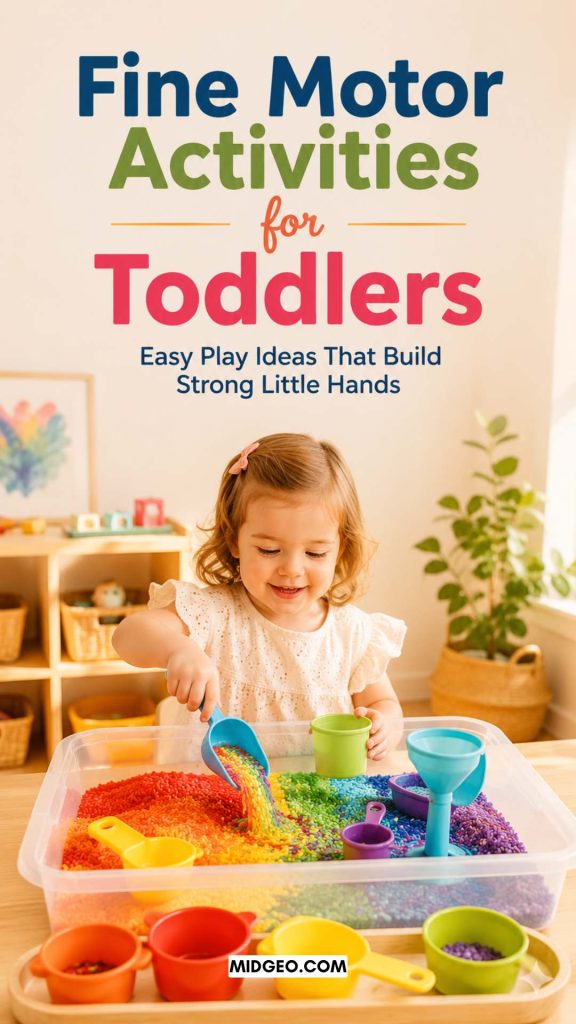
These simple, low-prep activities use common household items to help toddlers strengthen the small muscles in their hands and fingers, improve hand-eye coordination, and build independence. Best of all, they’re fun enough to keep little ones engaged while supporting fine motor skills for toddlers.
1. Scooping and Pouring with Dry Materials
Materials: Uncooked rice, dried beans, small pasta shapes, bowls, scoops, measuring cups, funnels
How to Do It: Fill one large bowl with your chosen dry material and place an empty bowl beside it. Show your toddler how to use a scoop or cup to transfer the materials from one bowl to another. Let them experiment with pouring, using funnels, and transferring between different container sizes.
Benefits:
- Builds wrist strength and stability
- Improves bilateral coordination (using both hands together)
- Develops precision and control
Variations:
- Add food coloring to rice or pasta for a colorful twist.
- Use themed containers (e.g., small pumpkin buckets in fall).
- Create a “fill to the line” game using a measuring cup marked with tape.
Pro Tip: Place a large towel or tray underneath for easy cleanup.
2. Tearing and Crumpling Paper
Materials: Scrap paper, tissue paper, construction paper, newspaper
How to Do It: Give your toddler different types of paper to rip into small pieces or crumple into balls. Encourage them to compare how each paper feels and how easy or hard it is to tear. Crumpled paper balls can be used later for art projects or indoor “snowball fights.”
Benefits:
- Strengthens the small muscles in fingers, hands, and wrists
- Improves pincer grasp and dexterity
- Prepares hands for scissor use
Variations:
- Sort torn pieces by color to add a learning element
- Glue torn paper pieces onto a large sheet to make a mosaic
- Have a timed “tear and toss” game into a basket
3. Stickers and Peeling Activities
Materials: Sticker sheets, contact paper, masking tape
How to Do It: Start with large, easy-to-peel stickers and gradually introduce smaller ones. Encourage your toddler to peel each sticker and place it on paper, a window, or a contact paper sheet taped sticky-side up.
Benefits:
- Improves pincer grasp
- Strengthens visual-motor integration (seeing and doing)
- Builds patience and concentration
Variations:
- Use themed stickers to match the season or learning topics (animals, numbers, shapes)
- Create a sticker scene on a poster board
- Stick masking tape to the table and have them peel it off for extra challenge
4. Pom-Pom Sorting
Materials: Pom-poms, tongs or tweezers, muffin tin or small bowls
How to Do It: Scatter pom-poms on the table. Give your toddler tongs or tweezers and show them how to pick up each pom-pom and place it into sections of a muffin tin, sorted by color or size.
Benefits:
- Strengthens hand muscles and coordination
- Improves grip strength and finger control
- Enhances sorting and categorizing skills
Variations:
- Use spoons instead of tongs for beginners
- Add a timer for a fun speed challenge
- Incorporate counting to combine math and motor skill practice
5. Water Play with Squeeze Toys
Materials: Sponges, turkey basters, pipettes, small cups or bowls of water
How to Do It: Set up a shallow tub or bowl of water and provide tools for squeezing and transferring water between containers. Show your toddler how to use each tool and encourage them to experiment.
Benefits:
- Strengthens grip and finger muscles
- Improves hand-eye coordination
- Provides sensory feedback through temperature and texture
Variations:
- Add food coloring to the water for extra fun
- Use the activity outdoors to minimize mess
- Challenge them to “fill the cup” with a set number of squeezes
Fine Motor Skills Activities for Preschool Classrooms
Teachers can weave fine motor development into daily routines by introducing fine motor skills activities preschool children find engaging, colorful, and connected to early learning goals.
1. Playdough Manipulation
Materials: Playdough, cookie cutters, rolling pins, plastic scissors, letter or number stamps
How to Do It: Encourage preschoolers to squish, roll, pinch, flatten, and shape the playdough. Introduce tools to create patterns, cut shapes, or press stamps for letter and number recognition.
Benefits:
- Builds hand and finger strength
- Enhances creativity and sensory exploration
- Supports pre-writing skills through finger dexterity
Learning Tip: Add natural scents (like cinnamon or lemon) to make it a multi-sensory experience.
2. Cutting Practice with Safety Scissors
Materials: Child-safe scissors, magazines, paper strips, printable cutting sheets
How to Do It: Begin with thick paper strips for stability. Progress to cutting out shapes from coloring sheets or magazine pictures. Provide visual cues with dotted lines for guidance.
Benefits:
- Develops hand strength and bilateral coordination
- Improves precision and control
- Prepares children for classroom tasks like cutting worksheets
Pro Tip: Incorporate cutting into art projects so it feels purposeful rather than repetitive.
3. Threading Beads or Pasta
Materials: Large beads, buttons, or penne pasta; shoelaces or yarn with taped ends
How to Do It: Demonstrate how to hold the string with one hand while sliding beads on with the other. Encourage patterns and color sequencing.
Benefits:
- Improves hand-eye coordination
- Strengthens both fine motor control and concentration
- Teaches early math skills like patterning
Variations:
- Use seasonal beads (pumpkins in fall, flowers in spring)
- Have children create wearable crafts like necklaces or bracelets
4. Push-Pin Art
Materials: Child-safe push pins, corkboard, printed outline drawings
How to Do It: Tape an outline drawing to a corkboard. Children push pins along the lines to “trace” the picture, then remove the paper to see the pattern of holes.
Benefits:
- Builds finger strength and precision
- Improves focus and patience
- Enhances tracing and pre-writing readiness
Safety Tip: Always supervise closely and store pins safely after use.
5. Clothespin Challenges
Materials: Wooden clothespins, string or wire, picture cards, small objects
How to Do It: Children clip clothespins onto objects, cards, or along a string. They can match colors, attach numbers in sequence, or simply transfer clothespins from one container to another.
Benefits:
- Strengthens pincer grasp
- Improves hand endurance
- Encourages problem-solving through themed challenges
Variations:
- Create a “clothespin counting line” with numbered cards
- Add a relay race element for extra excitement
Related: Learning Activities for Toddlers – Fun, Educational Play Ideas That Boost Development at Home

Magnetic Color & Number Maze Montessori Puzzle Board – A puzzle board designed for matching and counting, helping toddlers develop precision and problem-solving through magnetic play.

Learning Resources Sunshine Shape Sorter & Sensory Bin – Combines shape sorting with sensory bin play for engaging classification, hand-eye coordination, and tactile exploration.
Creative & Mess-Free Fine Motor Activities
For many parents, the words “fine motor activity” can sometimes mean glitter on the floor or paint on the walls. These ideas are perfect for those who want fun fine motor activities for kids without the cleanup stress. They’re portable, quick to set up, and still deliver big developmental benefits.
1. Pipe Cleaner Threading
Materials: Pipe cleaners, large beads (wooden or plastic), optional muffin tin for sorting
How to Do It: Give your toddler a selection of beads and pipe cleaners. Show them how to hold the pipe cleaner in one hand and thread beads with the other. The stiffness of the pipe cleaner makes it easier than string, which is ideal for beginners.
Benefits:
- Builds bilateral coordination (using both hands together)
- Strengthens pincer grasp and finger control
- Improves hand-eye coordination
Variations:
- Sort beads by color or size before threading
- Create color patterns to support early math skills
- Shape pipe cleaners into bracelets or animals afterward
2. Button Snake
Materials: Ribbon, large button, felt squares with small slits cut into them
How to Do It: Sew a large button to one end of a ribbon. Cut several felt squares and snip a small slit in the middle of each. Show your child how to push the button through the slit, “threading” the felt pieces onto the ribbon.
Benefits:
- Improves finger strength and dexterity
- Practices self-care skills like buttoning clothing
- Builds patience and sequencing ability
Variations:
- Use themed shapes for holidays (hearts, pumpkins, stars)
- Alternate colors to create patterns
3. Velcro Boards
Materials: Foam board or cardboard, Velcro strips or dots, felt shapes
How to Do It: Attach one side of the Velcro to the board and the other side to the back of felt shapes. Children can match, pull, and reposition the shapes as they wish.
Benefits:
- Strengthens finger muscles
- Enhances spatial awareness and matching skills
- Encourages creativity and imaginative play
Variations:
- Make shape-matching games (circles to circles, squares to squares)
- Use themed pieces like animals, vehicles, or seasonal symbols
4. Popsicle Stick Puzzles
Materials: Popsicle sticks, printed pictures or drawings, glue, clear tape or Mod Podge
How to Do It: Glue a photo or piece of artwork onto several popsicle sticks lined up side by side. Once dry, mix them up and challenge your toddler to reassemble the picture.
Benefits:
- Improves visual discrimination and problem-solving skills
- Strengthens fine motor coordination when aligning pieces
- Encourages attention to detail
Variations:
- Use your toddler’s own drawings for a personalized puzzle
- Create seasonal puzzles for thematic learning
5. Sensory Bags
Materials: Sealable plastic bags, clear hair gel or aloe gel, small items like beads, buttons, sequins, duct tape (to reinforce edges)
How to Do It: Fill the bag with hair gel, add small objects, then seal it tightly and secure the edges with tape. Place it flat on a table for toddlers to press, push, and move the objects around.
Benefits:
- Strengthens finger and hand muscles
- Provides sensory feedback without any mess
- Encourages curiosity and exploration
Variations:
- Create alphabet sensory bags and encourage letter recognition
- Add glitter for a visual “calm down” effect

TOP BRIGHT Magnetic Woodpecker Worm Feeding Game – A colorful magnetic game where children ‘feed’ worms to the bird, building fine motor strength and color recognition.

Melissa & Doug Primary Lacing Beads – A timeless classic featuring large wooden beads and laces, great for enhancing dexterity, pattern practice, and bilateral coordination.
Fine Motor and Gross Motor Combo Activities
Combining fine motor skills for toddlers with gross motor skills creates a full-body learning experience. These activities engage the brain’s coordination centers, improve focus, and help toddlers burn energy while practicing hand control.
1. Obstacle Course + Puzzle Piece Hunt
Materials: Puzzle board, large puzzle pieces, household items for obstacles (pillows, chairs, tunnels)
How to Do It: Set up an obstacle course in your living room or yard. Hide puzzle pieces at different points. Toddlers must climb, crawl, or balance to retrieve a piece and return it to the board before going after the next one.
Benefits:
- Builds problem-solving and memory skills
- Improves spatial awareness and body coordination
- Strengthens both fine and gross motor control
Variations:
- Use alphabet or shape puzzles for extra learning
- Add a timer for older toddlers to make it more challenging
2. Bowling with Set-Up
Materials: Foam or plastic bowling pins, soft ball
How to Do It: Have your child set up the pins themselves before rolling the ball to knock them down. Resetting the pins requires grip, precision, and controlled placement—fine motor benefits that complement the gross motor fun of bowling.
Benefits:
- Improves bilateral coordination
- Builds patience and sequencing skills
- Develops hand-eye coordination
Variations:
- Use empty water bottles as pins for a DIY version
- Fill bottles partially with rice or beans for extra stability
3. Balloon Tennis with a Twist
Materials: Balloons, lightweight rackets or fly swatters, clothespins or building blocks
How to Do It: Before each turn hitting the balloon, your child must complete a fine motor “challenge” like clipping a clothespin to a string or stacking three blocks.
Benefits:
- Boosts reaction time and coordination
- Strengthens grip and pincer grasp
- Adds cognitive sequencing to physical play
Variations:
- Change the fine motor task each round
- Use a timer to encourage faster transitions
4. Chalk Drawing + Balance
Materials: Sidewalk chalk
How to Do It: Draw large shapes, numbers, or lines on the ground. First, your child uses chalk to decorate or trace the shapes (fine motor). Then, they walk, hop, or balance along the lines (gross motor).
Benefits:
- Strengthens grip and writing readiness
- Enhances balance and spatial skills
- Encourages creativity
Variations:
- Create an outdoor “follow the path” game combining art and movement
- Turn the lines into a mini hopscotch for extra jumping practice
5. Ball Toss into Color-Coded Cups
Materials: Plastic cups in different colors, matching small items (pom-poms, balls), tongs or spoons
How to Do It: Line up cups and assign each a color. Using tongs or spoons, your toddler picks up items of the same color and drops them into the correct cup.
Benefits:
- Improves sorting and color recognition
- Builds hand strength and precision
- Combines movement with focused fine motor work
Variations:
- Space the cups farther apart for more running and bending
- Use different themes like animals or shapes instead of colors
Themed Fine Motor Activity Ideas (Seasonal + Holiday Fun)
Toddlers naturally respond to themes — they make activities feel new, exciting, and relevant to what’s happening around them. By tying motor skills activities for toddlers to seasons or holidays, you can spark curiosity while supporting fine motor development all year long.
Fall Fine Motor Activities
1. Leaf Hole Punching
Materials: Real leaves or leaf-shaped cardstock, child-safe hole punch
- Show your toddler how to squeeze the hole punch along the edges of a leaf.
- Builds hand strength and coordination while giving a fun “cause-and-effect” result.
2. Pumpkin Seed Sorting
Materials: Clean, dried pumpkin seeds, muffin tin, small cups
- Sort seeds by size or color (raw vs. painted).
- Enhances pincer grasp and early math skills.
3. Lacing Leaf-Shaped Cards
Materials: Cardstock leaves, hole punch, shoelace or yarn
- Punch holes around the edges and let your child “sew” the yarn through.
- Boosts bilateral coordination and focus.
Winter Fine Motor Activities
1. Cotton Ball Snowman with Tongs
Materials: Cotton balls, tongs, glue, paper snowman template
- Transfer cotton balls to fill the snowman’s body.
- Strengthens grip and precision while offering a sensory element.
2. Snowflake Sticker Placement
Materials: Snowflake stickers, blue or white paper
- Peel and stick to create a winter scene.
- Improves pincer grasp and spatial awareness.
3. Cranberry or Foam Shape Garland
Materials: Cranberries or foam shapes, blunt needle or pipe cleaner
- Thread items to create a seasonal garland.
- Supports bilateral coordination and patience.
Spring Fine Motor Activities
1. Flower Arranging in Foam Blocks
Materials: Artificial flowers, floral foam
- Toddlers push flower stems into the foam to “design” their arrangement.
- Strengthens fingers and encourages creative expression.
2. Bug Sticker Matching
Materials: Bug stickers, printed insect cards or drawings
- Match stickers to their matching picture.
- Builds visual discrimination and matching skills.
3. Watering Plants with Pipettes
Materials: Small plants, pipettes or droppers, water cup
- Squeeze water into plant pots.
- Improves hand control and introduces basic plant care.
Summer Fine Motor Activities
1. Sand Scooping with Cups
Materials: Sandbox or bin, cups, spoons, funnels
- Scoop and pour sand into different containers.
- Strengthens wrists, arms, and grip.
2. Ice Cube Painting
Materials: Ice cubes, food coloring, paper
- Let toddlers “paint” by rubbing colored ice on paper.
- Adds sensory and cooling fun to a hot day.
3. Seashell Sorting with Tweezers
Materials: Seashells, tweezers, sorting trays
- Sort by size, shape, or color.
- Enhances pincer grasp and attention to detail.
Holiday Fine Motor Activities
Valentine’s Day – Heart Button Snake
- Felt hearts with buttonholes threaded onto a ribbon with a button end.
- Builds buttoning skills and sequencing ability.
Halloween – Sticker Faces
- Pumpkin or ghost cutouts for toddlers to decorate with sticker eyes, noses, and mouths.
- Supports creativity and spatial placement.
Christmas – Ornament Threading
- Thread ribbon through paper or foam ornaments.
- Boosts bilateral coordination and holiday excitement.
Easter – Egg Peeling or Decorating
- Peel hard-boiled eggs for sensory fine motor work, or decorate with stickers and markers.
- Improves grip strength and finger control.
Quick Fine Motor Activities for Busy Days
Some days, you just need something fast, simple, and mess-free. These fun fine motor activities for kids can be set up in under two minutes but still give those little hand muscles a great workout.
1. 10-Minute Sensory Bin
- Fill a bin with rice, beans, or pasta. Add cups, scoops, or tongs.
- Perfect for calming play and building hand-eye coordination.
2. Sticker Match Game
- Draw simple shapes or letters on a paper plate. Have your toddler match stickers to the outlines.
- Boosts matching skills and pincer grasp.
3. Snack Sorting
- Use cereal, crackers, or goldfish to sort by shape or color into muffin tin sections.
- Combines snack time with skill-building.
4. Crayon Rubbings
- Place paper over textured surfaces (like coins, leaves, or fabric) and color over them.
- Strengthens grip and introduces textures.
5. Finger Tracing Letters
- Use shaving cream on a tray or sand in a shallow bin for tactile letter tracing.
- Supports early writing skills and sensory integration.
Fine Motor Toys Worth Investing In
Looking to build a mini fine motor kit at home or school? These toys and tools support ongoing skill development:
- Lacing beads and string kits
- Peg boards with color patterns
- Magnetic tile builders
- Montessori screw boards and locks
- Playdough kits with sculpting tools
- Child-safe scissors and cutting templates
- Button and zipper dressing frames
You can also DIY many of these using household materials, especially when on a budget.
How to Spot Progress in Fine Motor Development
Here’s how you’ll know your toddler is developing healthy fine motor skills:
- Picking up small snacks using fingers (pincer grasp)
- Using crayons or markers with better control
- Attempting to dress themselves (zippers, buttons)
- Building with blocks or stacking cups more precisely
- Holding scissors correctly (even if cutting isn’t perfect yet)
If you’re ever unsure about development, consult a pediatric occupational therapist for support and tailored activity suggestions.
Tips for Making Fine Motor Activities a Daily Habit
Even just 10–15 minutes a day of focused fine motor play can make a big difference.
- Create a fine motor station with rotating materials
- Pair activities with routines (like playdough while waiting for dinner)
- Let toddlers help with real tasks—peeling oranges, pouring water, buttoning shirts
- Follow their interests—animal beads, color sorting, or themed puzzles can boost motivation
- Be patient and make it fun—progress takes time, and messy effort is still progress
Final Thoughts,
Supporting your child’s development doesn’t need to be complicated or expensive. These fine motor activities for toddlers are not only fun—they’re incredibly effective in building skills through everyday play.
Whether you’re a parent looking for screen-free ideas or an educator planning preschool lessons, these simple tools and games will spark curiosity, independence, and confidence. Best of all, you can use things you already have at home—no prep-intensive projects required.
Ready to start building strong little hands and confident learners? Bookmark this list, try a few favorites, and don’t forget to share your toddler’s progress. There’s joy in every pinch, scoop, and squeeze.
Explore more ideas for motor skills activities for toddlers and gross motor activities for preschoolers indoor in our upcoming posts!