Formal Region Definition in Geography

The Region Definition of a Political boundary in International Law In political science and demography, the region is defined as any defined region within a country. A nation has regions which define it politically. A nation may also have informal regions.
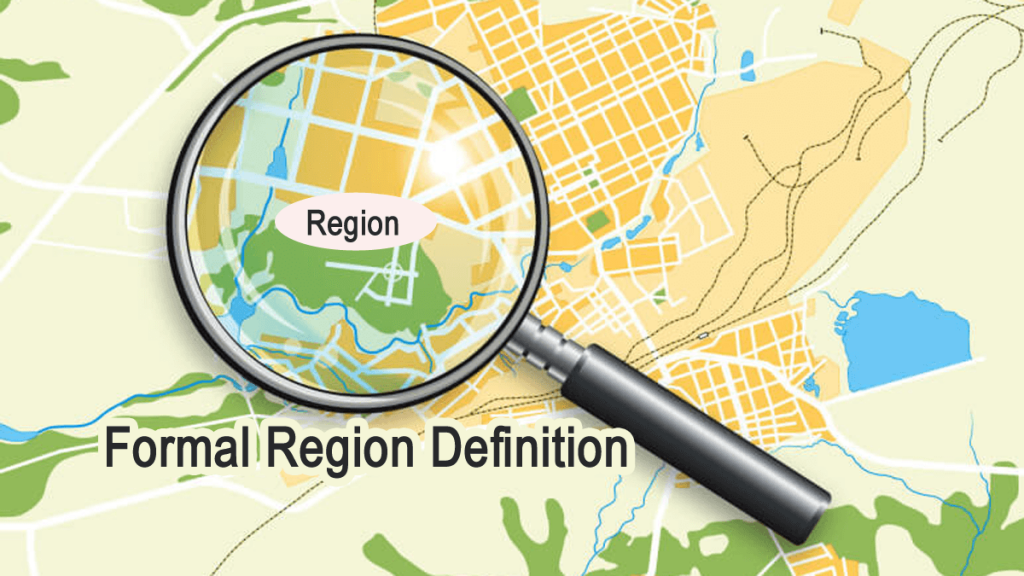
Formal Region Definition
A formal region is simply one sort of area and also stands out from perceptual regions and also functional regions.
First let’s know about the Region. you easily understand about formal region.
What is Region Definition?
A region is a big location of land that is various from various other locations of land, as an example, since it is just one of the various components of a nation with its very own custom-made and also features, or since it has a certain geographical attribute.
In a brief, an area is a location that shares both physical as well as human qualities.
What are the Different Types of Regions?
There are three types of region.
Formal Region (quantifiable data/borders) .
Functional Region (Business links) Region.
Perceptual (Vernacular Region) (Stereotype/feelings) .
Types of Regions
Formal (Uniform) Region
A formal area is a location that has actually formally acknowledged limits specifying it. Formal regions are commonly made up of the limits for cities, nations, areas, and also states. These regions are commonly considered open secret and also their limits established by nationwide or regional federal governments. Numerous standards are utilized to produce the regions. Some requirements a main entity might utilize to develop an area are political association, citizenship, society, usual languages, faith, geographical functions.
- *Areas in which they discovered specific qualities throughout the location.
A formal region is a location that has actually formally acknowledged borders specifying it. Formal regions are typically made up of the limits for cities, nations, states, and also regions. Some requirements a main entity might make use of to produce an area are political association, citizenship, society, usual languages, religious beliefs, geographical attributes.
A formal area can be any type of nation in the globe, like the France-speaking area of Canada, the dairying area of India, or political undercoating countries as well as states.
Instances Of Formal Regions,
An area is normally specified as a location bigger after that a solitary city which contains unifying society as well as physical attributes.
Formal Regions such as.
Nations.
States.
Cities.
All share the exact same legislations, federal government and so on
Instances of formal regions are differed. A formal area might be any type of nation worldwide, like the France-speaking area of Canada, the dairying area of India, or political undercoating countries as well as states.
Region Definition in Geography
Region Definition in Geography areas are large geographical regions which are widespread and highly demarcated by physical attributes, human influence characteristics, and the spatial interaction of humans with the environment. The boundaries of such areas change from time to time depending on changing needs, interests, and desires among people living in the region.
There are various explanations for why a political entity needs a region to demarcate itself from other entities in the same place. For instance, some nations which existed before the formation of any political entity have place which served as their administrative units. Such nations thus have a formal region definition, while other nations that lack administrative unit functioning are characterized by informal regions.
In this context, the first type of region is referred to as administrative boundaries, whereas the latter type of place is called a political region. The boundaries of an administrative place are usually defined by the government, which exercises administrative power over the region. The government may choose the size of position and determine what kind of authority or powers it enjoys over its residents. Similarly, in the case of nations that lack administrative power, a central political body may define the boundaries .
The central political body may also define the boundaries of the political subdivision of that nation. The boundaries thus determined typically correspond to those of the country’s parastatals. However, they may vary with respect to population and land ownership among different nations. A political entity cannot be thought of as a place unless it has an inclusive political boundary defined by an authoritative body exercising political jurisdiction.
In many cases, such boundaries are the product of long-standing territorial demarcations. In other cases, political boundaries are determined by the nature of the political entity, which includes a number of political entities sharing a single political identity and therefore overlapping in certain aspects. In still other cases, the political entity may define or delineate political boundaries where there are no legal ties whatsoever.
Generally, regions do not coincide with each other in geographical terms. Instead, political boundaries are determined by political entities exercising sovereign or absolute power. Within these entities, there can be multiple political entities exercising different sovereign authority. In this regard, the boundaries of a nation-state can also be considered as regions, since they overlap in various respects.
- Creating Natural Landscapes
- What is Cultural Geography
- Political Geography Important Definition
- Formal Region Definition in Geography
- Abiotic Factors- What are Actually Abiotic Factors
The term ‘regional’ itself can lend itself to further region definition, especially in the context of international law. International law recognizes the existence of seven economic zones. These are considered being regions by most authorities. However, despite the existence of seven economic zones, there can be no single political entity, which can be considered as a regional economic zone. This is because political boundaries are often considered being administrative places.
In the context of the United States, a state is considered being either a federal government or a unitary executive authority having powers derived from compact states. Similarly, there can be no single political subdivision which can be considered as a regional authority in the United States. Rather, there can only be two general types of political subdivision: federal and local. Political subdivisions are generally defined by both federal and local governments exercising powers derived from federal government power.
In short, a political subdivision which controls a substantial number of geographically defined limits may be considered as an administrative region. Such is the case when the powers deriving from the federal government power are concentrated in that region. For instance, the US region definition of the political subdivision of the American South could be considered as an administrative region since it controls a significant number of boundary disputes between other states.