History of Halloween: The Real Story Behind October 31 and Its Spooky Traditions (2026)
Picture October 31 after sunset: glowing pumpkins line the porch, children appear in costumes, candy bowls disappear surprisingly fast, and spooky decorations light up the neighborhood. But behind the costumes and jack-o’-lanterns is a much older story. The history of Halloween stretches across centuries and includes seasonal festivals, Christian observances, folk traditions, immigration, and modern popular culture.
So, why do we celebrate Halloween, and why has October 31 become associated with ghosts, costumes, pumpkins, and trick-or-treating?
The answer is more interesting than a single origin story. Halloween developed gradually as different customs overlapped and changed over time. Its history is commonly connected with the ancient Celtic festival of Samhain, while the name itself comes from the Christian observance of All Hallows’ Eve, the evening before All Saints’ Day.
In this guide, we’ll explore what Halloween is and why it is celebrated, how its traditions evolved, what the word means, why October 31 matters, and how religious questions surrounding Halloween are understood today.
What Is Halloween and Why Is It Celebrated?
Halloween has a surprisingly layered history.
It isn’t simply an ancient holiday that stayed unchanged.
It evolved over many generations.
That makes its story especially fascinating.
Halloween is generally observed on October 31 and is now known for costumes, trick-or-treating, parties, decorations, pumpkins, scary stories, and other forms of seasonal entertainment. In contemporary society, particularly in the United States, Halloween is largely treated as a secular cultural celebration, although its history includes both pre-Christian seasonal customs and Christian observances. The Library of Congress describes Halloween as having roots in the ancient Celtic festival of Samhain and later connections with All Saints’ and All Souls’ observances.
The important point is that Halloween does not have one simple starting date or one single source. Traditions developed in different places and periods.
Samhain is an important part of the historical discussion because it marked a seasonal transition around the beginning of November. Later, Christian observances associated with saints and the dead became connected with the same time of year. Over the centuries, folk customs, regional practices, immigration, and popular culture added more layers.
Today, people celebrate Halloween in many different ways. Some enjoy costumes and candy. Others focus on autumn gatherings, pumpkins, movies, crafts, or family activities. Some religious communities do not participate because of concerns about the holiday’s historical or symbolic associations.
Quick takeaway:
- Halloween is celebrated primarily as a cultural and seasonal holiday today.
- Its history includes Samhain and Christian All Hallows’ observances.
- Modern Halloween is different from its historical predecessors.
- Different families and religious communities may observe it differently.
Actionable tip: When explaining Halloween to children, describe it as a holiday whose traditions developed over time rather than claiming that every modern custom comes directly from one ancient festival.
Related: 35 Halloween Bucket List Ideas to Make October Unforgettable
The Ancient Roots of Halloween: Samhain
This is where the history gets especially interesting.
The name Halloween came later.
Samhain is one of the major traditions historians discuss when examining Halloween’s early roots.
But modern Halloween should not be treated as identical to ancient Samhain.
Samhain was a Gaelic seasonal festival associated with the end of the harvest and the beginning of winter. It was traditionally observed around November 1, meaning the evening before it corresponded to what became October 31 on the modern calendar. The Library of Congress identifies Samhain as an ancient pre-Christian Celtic festival and explains that later Christian observances became intertwined with existing traditions.
Historical descriptions of Samhain often emphasize seasonal change, the harvest, bonfires, supernatural folklore, and beliefs about the boundary between the living and the dead. However, some popular Halloween articles present these beliefs as if every detail were universally practiced by all ancient Celtic people. That is too simplistic.
Much of what we know about ancient Celtic traditions comes from later sources and regional folklore. The Smithsonian notes that there is limited direct historical evidence for exactly what happened during early Samhain celebrations and that some commonly repeated stories belong more to later legend than firmly documented ancient practice.
This distinction matters because the dark origins of the holiday are often exaggerated online.
Samhain was fundamentally connected with a seasonal transition and the agricultural calendar. Over time, supernatural stories and customs became part of the folklore surrounding the date.
Important points about Samhain:
- It was associated with the end of the harvest.
- It marked a transition into the darker part of the year.
- It was connected with supernatural folklore.
- Bonfires were associated with some celebrations.
- Costumes and disguises became part of related traditions.
- Modern Halloween is not simply a unchanged version of Samhain.
Pro tip: If you’re writing about Halloween history, use phrases such as “associated with,” “traditionally believed,” and “over time” when discussing customs for which the historical evidence is incomplete.
Related: Halloween Movies to Watch: 31 Must-Watch Halloween Movies for a Spooky October
Why Was October 31 Connected With Halloween?
Why October 31?
The date is not random.
It sits immediately before November 1.
That relationship is central to understanding Halloween’s name and history.
The seasonal significance of the period around November 1 predates the modern Halloween calendar date. Samhain was traditionally associated with the beginning of winter and the end of the harvest season. Later, November 1 became associated with All Saints’ Day in Western Christianity, making October 31 the evening before that feast.
The Library of Congress explains that Christian missionaries and church authorities introduced All Saints’ Day and All Souls’ Day into a period that had existing Celtic traditions. Over time, Christian and pre-Christian customs became intertwined in parts of Europe.
This helps answer the question, “Why is Halloween celebrated on October 31st?”
October 31 became associated with Halloween because it was the eve of All Hallows’ Day, or All Saints’ Day, on November 1. The date also retained connections with older seasonal traditions.
In other words, the modern date reflects both calendar history and cultural evolution.
Remember these connections:
- Samhain was associated with the beginning of the winter season.
- November 1 became All Saints’ Day in Western Christianity.
- October 31 became the evening before All Saints’ Day.
- “All Hallows’ Eve” eventually became “Halloween.”
- Modern Halloween absorbed many additional cultural traditions.
Quick tip: Don’t describe October 31 as exclusively “the ancient Celtic New Year.” Historical practices varied, and the modern Halloween date developed through multiple traditions.
Related: 50+ Fun Halloween Party Games for All Ages
What Is the Meaning of the Word Halloween?
The word itself provides an important historical clue.
It sounds mysterious, but its linguistic history is surprisingly straightforward.
“Halloween” is connected to a Christian feast day.
The shorter modern name developed from an older phrase.
The word Halloween comes from All Hallows’ Eve, meaning the evening before All Hallows’ Day, another historical name for All Saints’ Day. “Hallow” is an old English word connected with holiness or a saint, while “even” or “eve” refers to the evening before a particular day.
Historical forms included spellings such as “Hallowe’en” and “All Hallows Even.” The word gradually contracted into the familiar “Halloween.” Records of the term go back centuries, with early forms appearing in Scottish usage.
So, what is the meaning of the word Halloween?
In simple terms, it means the evening before All Hallows’ Day, or All Saints’ Day.
That linguistic origin is important because it demonstrates that Halloween’s history cannot accurately be described as exclusively pagan or exclusively Christian. The holiday’s modern identity developed through interaction between different cultural and religious traditions.
Word history at a glance:
- Hallow → holy person or saint
- Hallows → saints
- All Hallows’ Day → All Saints’ Day
- All Hallows’ Eve → evening before All Saints’ Day
- Halloween / Hallowe’en → shortened form
Actionable takeaway: If someone asks what Halloween literally means, start with its linguistic meaning—”All Hallows’ Eve”—before discussing the broader history of its traditions.
How Christian Traditions Became Part of Halloween
The Christian connection deserves its own explanation.
It is often simplified into a single historical event.
The reality is more gradual.
Several observances became associated with the beginning of November.
All Saints’ Day is a Christian feast honoring saints and is observed on November 1 in Western Christianity. The Library of Congress notes that Christian observances associated with All Saints and All Souls became intertwined with existing Celtic seasonal traditions, contributing to the development of Halloween.
The evening before All Saints’ Day became known as All Hallows’ Eve. Later, November 2 became associated with All Souls’ Day, an observance connected with remembering the departed. These neighboring observances helped create a broader period in which ideas about saints, souls, death, remembrance, folklore, and the supernatural overlapped.
This history also helps explain why Halloween has sometimes been described as having both Christian and pre-Christian influences.
However, saying that the Christian church simply “invented Halloween” would be misleading. Likewise, saying Halloween is simply an unchanged pagan festival would also ignore centuries of Christian and later cultural development.
The historical picture is more complicated:
- All Saints’ Day is Christian.
- All Souls’ Day is Christian.
- All Hallows’ Eve became the name for October 31.
- Older seasonal customs existed around the same time of year.
- Folk traditions blended and changed across centuries.
- Modern Halloween developed much later.
Pro tip: Think of Halloween as a cultural “layer cake.” Each historical period added something new.
How Halloween Traditions Changed in Medieval Europe
The holiday did not suddenly become today’s costume-and-candy celebration.
Medieval customs looked very different.
Food, prayers, disguises, and community traditions played important roles.
Some of these customs eventually influenced modern Halloween.
One historical tradition connected with All Souls’ observances was souling. In some parts of medieval Europe, people went door to door offering prayers for the dead in exchange for food. Another related custom involved disguise, performance, or visiting homes during seasonal celebrations.
The Smithsonian explains that medieval traditions such as souling and related practices helped form part of the long history behind modern door-to-door Halloween customs.
These traditions should not be treated as identical to modern trick-or-treating. Children today generally receive commercially packaged candy, while medieval customs could have religious elements and involved different foods, social groups, and purposes.
Still, the underlying pattern is recognizable: people visiting homes, offering something, and receiving food in return.
That basic structure survived in modified forms as Halloween developed.
Examples of older traditions include:
- Souling
- Singing or reciting verses
- Asking for food
- Disguises and costumes
- Community gatherings
- Seasonal games
- Fortune-telling customs
- Bonfires
Small action: When teaching children about Halloween history, compare “souling” and modern trick-or-treating as examples of how a tradition can change its meaning while keeping a recognizable structure.
Where Did Trick-or-Treating Come From?
The modern Halloween doorstep scene feels completely normal.
But the tradition has a long history.
It wasn’t created overnight.
It developed from several older customs.
Modern trick-or-treating has connections to earlier European traditions involving door-to-door visits, food, costumes, begging, and seasonal celebrations. The Smithsonian traces some of these influences through Samhain-related customs, medieval souling, and later Scottish and Irish practices.
The phrase “trick or treat” itself is much more recent than Samhain. In North America, the practice became increasingly recognizable during the 20th century and expanded significantly after World War II. The availability of commercially packaged candy, suburban neighborhoods, and organized community celebrations helped shape the modern version.
So the history of trick-or-treating is really a story of adaptation.
Older influences included:
- Souling
- Guising
- Mumming
- Door-to-door begging
- Costumes and disguises
- Offering food
Modern influences include:
- Individually wrapped candy
- Children’s costumes
- Neighborhood routes
- Halloween parties
- Community safety programs
Common mistake: Saying that ancient Celtic people went door to door asking for chocolate candy. They obviously did not have today’s commercial Halloween candy culture.
Quick tip: Explain trick-or-treating as a modern tradition with older European influences rather than an ancient custom that has remained unchanged.
Why Do People Wear Halloween Costumes?
Costumes are one of Halloween’s most recognizable traditions.
But their history is older than today’s superheroes and movie characters.
Disguises had a deeper connection with folklore.
Over time, their meaning changed dramatically.
Historical accounts associate costumes and disguises with Halloween-related traditions in Ireland and Scotland. The Smithsonian describes costume-wearing as part of the folklore surrounding Samhain and later notes that European immigrants brought costume traditions to the United States during the 19th century.
Historically, disguises could be associated with supernatural beliefs, seasonal celebrations, entertainment, or social customs. In modern Halloween culture, however, costumes are generally recreational.
People dress as:
- Witches
- Ghosts
- Superheroes
- Animals
- Historical characters
- Movie characters
- Pop-culture figures
- Funny or creative characters
The modern costume has also become a form of self-expression.
That is an important transformation. A practice once connected to folklore and seasonal beliefs can eventually become a creative activity enjoyed for entertainment.
Pro tip: When writing family-friendly Halloween content, describe costumes as a cultural tradition that evolved over time rather than assigning one universal meaning to them.
Why Do We Carve Pumpkins?
Few images are more strongly associated with Halloween than a glowing jack-o’-lantern.
But pumpkins were not the original material.
The story actually begins with root vegetables.
America helped transform the tradition.
Carving vegetables has a long connection with Halloween traditions in Ireland and Scotland. Turnips and other root vegetables were historically carved into lanterns or faces. When Irish immigrants brought Halloween traditions to North America, pumpkins became an especially practical choice because they were abundant and easier to carve.
This is one of the clearest examples of how immigration changed Halloween.
The pumpkin was not simply an ancient Celtic Halloween symbol that had always existed. It became popular because the American environment offered a different crop that worked extremely well for the tradition.
Today, jack-o’-lanterns are used for:
- Porch decorations
- Centerpieces
- Children’s activities
- Halloween parties
- Pumpkin-carving contests
- Outdoor displays
Interesting fact: Pumpkins are native to the Americas, which is why they could not have been the traditional carving material of ancient Celtic Europe.
Actionable idea: If you’re making a Halloween history lesson for children, show a picture of a carved turnip next to a pumpkin. It makes the evolution of the tradition easy to understand.
How Halloween Came to America
This is the chapter where Halloween began to look more familiar.
Immigration carried traditions across the Atlantic.
American communities adapted them.
Eventually, Halloween became a major cultural celebration.
Halloween traditions came to North America through European immigration, particularly from Ireland and Scotland. The Smithsonian notes that large numbers of Irish and Scottish immigrants arrived in the United States during the 19th century, bringing seasonal customs that influenced American Halloween.
Once these traditions arrived in America, they encountered a different environment and different cultural influences. Pumpkin carving became easier because pumpkins were widely available. Community parties and neighborhood celebrations grew. Costumes became increasingly common.
By the 20th century, Halloween had become increasingly commercialized and child-centered.
The Library of Congress describes modern Halloween as a worldwide cultural phenomenon that has become particularly secular and commercial in the 21st century.
Major developments included:
- European immigration brought Halloween customs.
- American communities adapted regional traditions.
- Pumpkin carving became popular.
- Costumes became increasingly recreational.
- Trick-or-treating expanded.
- Candy companies and retailers commercialized the holiday.
- Halloween spread internationally through media and popular culture.
Quick tip: When discussing American Halloween, remember that immigration was a major reason the holiday developed into the form many people recognize today.
The Dark Origins of Halloween: What Is Fact and What Is Legend?
Halloween certainly has a spooky reputation.
But spooky stories aren’t always historical evidence.
Some popular claims have been repeated so often that they sound like facts.
This is where careful research matters.
One of the biggest misconceptions about Halloween is that every frightening modern tradition can be traced directly to ancient Celtic religious rituals. The historical evidence is more complicated.
The Smithsonian notes that many stories about Samhain come from later traditions and that there is limited direct evidence documenting exactly what happened during early celebrations.
For example, online articles sometimes claim that ancient Samhain participants regularly performed specific dramatic rituals or that Halloween was universally centered on sacrificing people. Such claims should be treated with extreme caution unless supported by strong historical evidence.
There is a documented connection between Samhain, seasonal change, supernatural folklore, bonfires, and costumes. But historians distinguish between evidence, later folklore, and modern storytelling.
When researching Halloween history, separate:
- Documented history
- Later folklore
- Religious tradition
- Popular legend
- Modern entertainment
- Internet myths
This distinction makes your article more trustworthy.
Common mistake: Using words such as “definitely,” “always,” or “everyone” when discussing ancient Halloween customs.
Pro tip: If a historical claim sounds extremely dramatic, check whether it comes from a primary source, a reputable historian, a museum, or merely a modern viral article.
Is Halloween a Religious Holiday?
This question does not have one universal answer.
It depends partly on what someone means by “Halloween.”
Its history contains religious elements.
Its modern celebration is often secular.
Halloween has historical connections to both pre-Christian Celtic traditions and Christian observances surrounding All Saints’ Day and All Souls’ Day. The name itself comes from the Christian calendar through All Hallows’ Eve.
At the same time, contemporary Halloween in many countries is primarily a cultural and commercial event. People may celebrate with costumes, candy, decorations, pumpkin carving, parties, or seasonal activities without treating the occasion as a religious observance. The Library of Congress specifically describes modern Halloween as a secular and highly commercial holiday.
So asking “Is Halloween a religious holiday?” requires context.
Historically:
- It has connections to Christian observances.
- It also developed alongside older seasonal customs.
Today:
- Some Christians observe it religiously or culturally.
- Some Christians avoid it.
- Many secular communities celebrate it as entertainment.
- Other religious communities may not participate.
There is no need to assume that every person celebrating Halloween understands or practices it in the same way.
Actionable takeaway: When discussing Halloween and religion, distinguish the holiday’s historical development from how an individual or community chooses to observe it today.
Does the Bible Say Anything About Halloween?
This is one of the most searched questions about Halloween.
The short answer requires an important distinction.
The Bible does not describe the modern holiday of Halloween by name.
Some biblical passages are nevertheless frequently discussed in conversations about it.
The Bible predates the development of Halloween as the modern holiday we know today, so there is no biblical passage specifically describing “Halloween.”
However, some Christians consider passages concerning witchcraft, divination, consulting spirits, and occult practices when deciding how they personally view Halloween. For example, Deuteronomy 18:10–12 specifically warns against practices including divination, sorcery, witchcraft, and consulting the dead. Ephesians 5:11 encourages believers to avoid “fruitless deeds of darkness.”
These passages do not mention Halloween itself.
That distinction is important.
Christian denominations and families can interpret the relationship between these biblical teachings and modern Halloween activities differently. Some avoid costumes or activities they believe imitate occult practices, while others participate in non-occult activities such as community gatherings, harmless costumes, or family events.
Important distinction:
- The Bible does not contain a chapter about Halloween.
- The word “Halloween” does not appear as a modern holiday instruction.
- Biblical passages about occult practices are sometimes applied by Christians when evaluating Halloween.
- Individual Christian traditions may reach different conclusions.
Pro tip: Avoid saying “the Bible says Halloween is forbidden” as a direct quotation or biblical fact. A more accurate statement is that some Christians use biblical teachings about occult practices when deciding whether and how to participate in Halloween.
Can Muslims Celebrate Halloween?
This is a religious question, so it is important to present different scholarly approaches rather than pretending there is one universal Muslim position.
Muslims may encounter Halloween through schools, neighborhoods, workplaces, or social media. Families then have to decide how they want to respond. Islamic scholars and institutions have generally not treated the question as merely a historical one; they examine Halloween in relation to Islamic beliefs about religious festivals, imitation, and participation in non-Muslim celebrations.
For example, IslamWeb takes a strict position that Muslims should not participate in Halloween or congratulate others on it.
The Yaqeen Institute for Islamic Research also presents a critical view of participating in Halloween and emphasizes questions of religious identity and the desire to fit in with surrounding culture.
At the same time, Muslims are not a monolithic community, and individual families may distinguish between religious participation and ordinary social interaction in different ways.
For a Muslim family trying to make a decision, useful questions may include:
- Is the activity being treated as a religious celebration?
- Does it involve practices that conflict with Islamic beliefs?
- Is participation expected at school or work?
- Can children enjoy a seasonal activity without participating in religious symbolism?
- What guidance does the family’s trusted scholar or local Islamic community provide?
Important: This article is a historical and educational overview, not a personal religious ruling.
Actionable advice: If you’re a Muslim parent unsure about Halloween participation, discuss the specific activity—not just the word “Halloween”—with a trusted, qualified Islamic scholar who understands your family’s circumstances.
How Halloween Became a Modern Commercial Holiday
Today’s Halloween looks very different from its historical beginnings.
Candy aisles appear months in advance.
Costumes fill stores and online marketplaces.
Decorating has become an entire seasonal industry.
Modern Halloween has become heavily commercialized, particularly in the United States. Candy, costumes, decorations, greeting cards, party supplies, movies, events, and seasonal experiences now form a large part of the holiday economy.
The Library of Congress describes 21st-century Halloween as a secular and highly commercial holiday that has also spread globally.
This commercialization has changed how many people experience Halloween.
Instead of focusing primarily on folklore or religious observances, modern families may spend October:
- Decorating their homes
- Visiting pumpkin patches
- Planning parties
- Choosing costumes
- Carving pumpkins
- Watching Halloween movies
- Baking seasonal treats
- Creating crafts
- Going trick-or-treating
- Attending community events
Social media has accelerated this transformation by turning Halloween décor, costumes, recipes, and parties into highly visual content.
Pro tip: You don’t need to spend heavily to enjoy Halloween. Many of its most recognizable traditions—pumpkin carving, homemade costumes, spooky stories, and family games—can be inexpensive.
How Halloween Spread Around the World
Halloween is no longer limited to the places where its historical traditions developed.
Movies and television helped spread familiar imagery.
Social media accelerated the trend.
But different countries often adapt Halloween in their own ways.
The Library of Congress notes that Halloween is now celebrated worldwide and reflects the assimilation of different cultures.
That does not mean Halloween looks exactly the same everywhere.
In some places, it is primarily a children’s event. In others, it is associated with parties, costumes, entertainment, or retail promotions. Some communities barely observe it at all.
It is also important not to confuse Halloween with Día de los Muertos, or Day of the Dead. These are distinct traditions with different histories, even though they can occur around the same time and may both include imagery associated with death and remembrance. The Library of Congress specifically describes Día de los Muertos as a related but different tradition with Indigenous Mexican roots that later blended with Catholic observances.
Remember:
- Halloween has European roots.
- It developed substantially in North America.
- It has spread internationally.
- Local cultures adapt it differently.
- Día de los Muertos is not simply “Mexican Halloween.”
Actionable tip: When creating international Halloween content, avoid treating American customs as universal. Ask how the holiday is actually observed in the country or community you’re discussing.
Common Halloween History Myths to Avoid
Halloween history is full of fascinating stories.
It is also full of myths.
Some are based on real traditions but become exaggerated.
Others simply aren’t supported by good evidence.
Here are several claims worth treating carefully.
Myth: Halloween Is Exactly the Same as Samhain
It isn’t. Samhain is an important historical influence, but Halloween developed through many centuries of cultural and religious change.
Myth: Pumpkins Were Used by Ancient Celts
Pumpkins originated in the Americas. European Halloween traditions historically used vegetables such as turnips before pumpkins became popular in North America.
Myth: Trick-or-Treating Is Thousands of Years Old
Its older influences include seasonal customs and door-to-door practices, but modern trick-or-treating developed much later.
Myth: Halloween Is Purely Pagan
The modern holiday includes a mixture of influences, and its name comes from All Hallows’ Eve, a Christian observance.
Myth: Halloween Is Purely Christian
That also leaves out the older seasonal and folk traditions that became part of its development.
Myth: Everyone Celebrates Halloween for the Same Reason
People celebrate—or avoid—it for many different cultural, religious, and personal reasons.
Research checklist:
- Look for reputable museums.
- Check the Library of Congress.
- Use academic or historical sources.
- Distinguish folklore from documented evidence.
- Avoid sensational claims.
- Check whether a claim applies to ancient history or modern practice.
Quick tip: The most interesting Halloween stories are often the ones that acknowledge uncertainty rather than pretending every detail is settled.
What Is the Real Story Behind Halloween?
After all these centuries, what is the real story?
It is not one dramatic beginning.
It is a story of cultural change.
That is what makes Halloween so interesting.
The real history of Halloween is best understood as a long process of cultural layering.
Ancient seasonal traditions associated with Samhain contributed important folklore. Christian observances around All Saints’ Day and All Souls’ Day became associated with the same period. Medieval European customs such as souling and disguises influenced later traditions. Irish and Scottish immigrants carried customs to North America. American communities then adapted them into new forms, including widespread pumpkin carving, children’s trick-or-treating, costume parties, and commercial Halloween celebrations.
That means Halloween is neither a frozen ancient ritual nor a holiday invented in modern America.
It is an evolving cultural tradition.
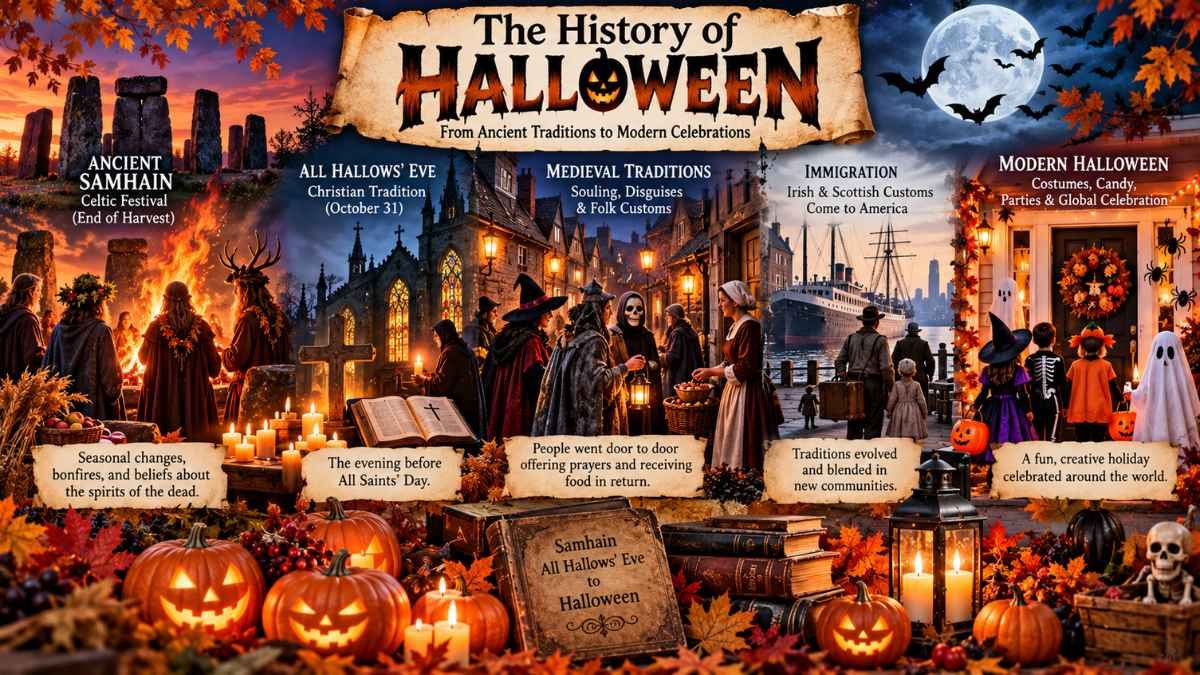
The simplest timeline is:
- Ancient Celtic seasonal traditions → Samhain and the end of harvest.
- Christian calendar traditions → All Saints’ Day and All Souls’ Day.
- All Hallows’ Eve → October 31 becomes associated with the evening before All Saints’ Day.
- Medieval customs → Souling, disguises, food, and community traditions.
- 19th-century immigration → Irish and Scottish customs reach North America.
- 20th-century America → Costumes, trick-or-treating, parties, and pumpkin carving expand.
- Modern Halloween → A global, highly commercial cultural celebration.
Actionable takeaway: When someone asks for “the real story behind Halloween,” the most accurate answer is not one origin story but a timeline showing how different traditions gradually came together.
How to Explain the History of Halloween to Kids
Kids usually have one big question.
“Why do we do this?”
The answer doesn’t need to be complicated.
A simple timeline can make history memorable.
For children, explain Halloween as a holiday that changed over a very long period.
You might say:
“Long ago, people in parts of Europe had seasonal festivals connected with the end of harvest and the beginning of winter. Later, Christian celebrations honoring saints and remembering the dead became associated with the same time of year. Over hundreds of years, people added costumes, games, food, lanterns, and other traditions. Eventually, Halloween became the fun, spooky celebration many people know today.”
Then use familiar objects as teaching tools.
- Pumpkin: Ask why people carve pumpkins.
- Costume: Explain how disguises changed over time.
- Candy: Compare modern treats with older food-giving traditions.
- Lantern: Explain the earlier use of carved turnips.
- October 31: Explain its connection to All Hallows’ Eve.
This approach teaches history without frightening children or presenting uncertain legends as facts.
Pro tip: For younger children, focus on seasonal traditions and cultural history. Save complicated religious or historical debates for older learners who can understand nuance.
A Simple Halloween History Timeline
A timeline makes the whole subject easier to remember.
There are many dates involved.
But you don’t need to memorize hundreds of years.
Focus on the major transitions.
Ancient and Early Traditions
Samhain became an important reference point for understanding the seasonal traditions that later influenced Halloween. It was associated with the end of the harvest and the transition into winter.
8th Century
All Saints’ Day became associated with November 1 in Western Christianity, helping establish October 31 as the evening before All Hallows’ Day. The Library of Congress notes the role of Christian observances in the later blending of traditions.
Medieval Period
Customs involving prayer, food, disguises, and door-to-door visits developed in different regions.
16th–18th Centuries
The name Halloween developed through forms of All Hallows’ Eve, while Scottish and Irish folk traditions continued to evolve.
19th Century
Irish and Scottish immigrants helped bring Halloween customs to North America.
20th Century
American Halloween increasingly became associated with children’s costumes, neighborhood celebrations, candy, parties, and trick-or-treating.
21st Century
Halloween has become an increasingly global and commercial cultural celebration.
Save-worthy timeline:
Samhain → All Saints’ Day → All Hallows’ Eve → Medieval folk traditions → Immigration → American Halloween → Global modern Halloween
Quick tip: Save this timeline as a reference if you’re creating Halloween history content for your blog, classroom, or social media.
Why Halloween History Still Matters Today
At first glance, Halloween may seem like a simple candy-and-costume holiday.
But its history tells a much bigger story.
It shows how traditions travel.
It also shows how cultures change them.
Studying Halloween history helps us understand how cultural traditions evolve.
A custom can begin in one historical context and develop a completely different meaning generations later. Immigration can transport traditions to another country. Religious institutions can influence seasonal celebrations. Commercial businesses can transform a local tradition into a global industry.
Halloween is an excellent example of this process.
It also encourages us to think carefully about cultural identity. Two people can participate in the same modern activity while understanding it very differently.
For one person, Halloween might mean:
- A children’s neighborhood event
- A creative costume
- Pumpkin carving
- Autumn decorating
- A family party
- A religiously significant evening
- A cultural tradition
- A commercial holiday
None of these experiences automatically tells the entire historical story.
Actionable takeaway: The next time you see a Halloween decoration, costume, or trick-or-treat bag, think about how many centuries of cultural change helped create that familiar tradition.
Frequently Asked Questions About the History of Halloween
Halloween questions often sound simple.
The historical answers are usually more nuanced.
Here are the questions readers ask most often.
Use these as a quick reference.
Why Do We Celebrate Halloween?
Today, people celebrate Halloween mainly as a cultural and seasonal event involving costumes, candy, parties, decorations, pumpkin carving, and community activities. Historically, Halloween developed from a combination of seasonal traditions and Christian observances associated with the period around November 1.
Quick takeaway: Modern Halloween is not practiced everywhere for the same reason.
What Is Halloween and Why Is It Celebrated?
Halloween is observed on October 31 and is commonly associated with costumes, trick-or-treating, pumpkins, and spooky entertainment. Its name derives from All Hallows’ Eve, while its broader history includes older seasonal traditions and later European and American customs.
Quick tip: Explain both the historical and modern meanings.
Why Is Halloween Celebrated on October 31st?
October 31 is the evening before November 1, traditionally known in Western Christianity as All Saints’ Day or All Hallows’ Day. The date also overlaps with the period associated with Samhain and older seasonal traditions.
Actionable takeaway: Think of October 31 as a date shaped by multiple historical layers.
What Is the Meaning of the Word Halloween?
Halloween comes from All Hallows’ Eve, meaning the evening before All Hallows’ Day. “Hallow” refers historically to a holy person or saint.
Quick tip: The name itself has a clear Christian linguistic origin even though the modern holiday contains many different influences.
Is Halloween a Religious Holiday?
Halloween has religious elements in its history, including its connection to All Saints’ Day and All Souls’ Day, but modern Halloween is often celebrated as a secular cultural holiday. Different religious communities interpret it differently.
Remember: Historical origin and modern practice are not always the same thing.
Does the Bible Say Anything About Halloween?
The Bible does not specifically mention the modern holiday of Halloween. Some Christians consider biblical teachings concerning witchcraft, divination, sorcery, or consulting the dead when deciding whether to participate.
Important: Biblical passages concerning occult practices should not be presented as if they directly name Halloween.
Can Muslims Celebrate Halloween?
Muslim scholars and communities differ in how they discuss participation, but some Islamic authorities strongly discourage or prohibit Halloween participation because they regard it as a non-Islamic festival. IslamWeb, for example, explicitly prohibits participation, while Yaqeen Institute presents concerns about religious identity and participation.
Practical advice: Muslims should consult a trusted qualified scholar for guidance applicable to their own circumstances.
What Is the Real Story Behind Halloween?
The real story is a long process of cultural evolution involving seasonal Celtic traditions, Christian observances, medieval customs, immigration, American popular culture, and modern commercialization. There is no single event that created the Halloween celebrated today.
Quick takeaway: Halloween is best understood as a tradition built over centuries.
Conclusion
The history of Halloween is much richer than pumpkins, costumes, and candy. Its story stretches from ancient seasonal traditions associated with Samhain through Christian observances such as All Saints’ Day and All Souls’ Day, medieval customs, European immigration, and the development of modern American Halloween.
Understanding why we celebrate Halloween also means recognizing that traditions change. The meaning of a costume, pumpkin, or trick-or-treat visit today may be very different from its historical predecessors. The same is true when considering questions such as whether Halloween is religious, what the Bible says about it, or whether Muslims should participate.
There is no need to rely on sensational myths to make Halloween history fascinating. The real story is already full of cultural change, folklore, migration, and surprising traditions.
Save this guide, share it with a curious friend, and explore one piece of Halloween history this October.